Cades Cove Driving Tour Part 3

Cades Cove Driving Tour part 3 in the Great Smoky Mountain National Park


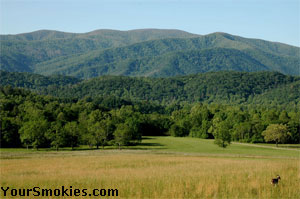
By this point you should be starting to notice that at almost every twist and turn on the road you see a new vista unfold. Add to that the changing seasons and you can see why some people visit the Cove hundreds of times and still feel as though they have not seen all there is too see in the magical part of the Smoky Mountain National Park.

Since the first time I visited the park in the early 60s Cades Cove has been changing - for the good. While some of the older buildings are still here some of the more modern buildings were removed long ago and the park itself is returning more to its natural state. It's up to all of us to make sure we help by not destroying wildlife, artifacts or laving trash.

Cades Cove Driving Tour Stop 10


The Elijah Oliver Place is one of the nicest cabins to visit with cades Cove but due to heavy erosion the area is now closed while the Park maintenance staff work to rehabilitate the badly erodes area around the cabin due to over visitation and poor drainage in the area.

When the Elijah Oliver Place is reopened we will post our descriptions as well as our photos of the area. For now it is unsafe and illegal to enter the work area.

Abrams Falls Trailhead
You are now on the far western end of the Cades Cove loop and will shorty see the road to the Abrams Falls Trail on the right hand side. The Abrams Falls Trail is incredible popular for good reason. What starts along a creek bed ends up in a spectacular waterfall with a beautiful pool below. If you only have a few days in the park and can handle a 5 mile hike, this hike should be tops on your list. Be cautioned that the road to the trailhead is 2 way.

Gregg Cable house, cane mill and molasses furnace.          The John P Cable Grist Mill which was built in 1870.
Gregg Cable house, cane mill and molasses furnace.          The John P Cable Grist Mill which was built in 1870.    


Cades Cove Driving Tour Stop 11


The Cable Mill Historic area is a perfect place to take a break and walk around history.

Start at the visitor center which has bathrooms outside. The Cable Mill Historic visitor center which was built in 1972 is open daily but may close in the winter during inclement weather.

All the historic buildings and exhibits other than the John P Cable grist mill were brought to this spot in Cades Cove form other areas of the park. Easy to navigate paths will take you from building to building making this section of historic buildings the most assessable to those with special needs.

As you wander through the Cable Mill Historic area you will see a blacksmith shop, cantilever barn, damn, millrace, grist mill, smokehouse, the Gregg Cable house, corn crib, barn, sorghum mill and molasses furnace.

Cades Cove was a farming community that flourished in the 1800s into the early 1900s. Farmers alone could not support the entire community as the settlers needed the products that the blacksmith was able to make or repair and the labor that the mill was able to provide in the form of a grist mill as well as a sawmill to cut logs into lumber.

Blacksmith Shop
The first building that after the Cades Cove visitors center is the blacksmiths shop. While the Smokies are not loaded with iron ore, there were in fact originally called the Great Iron Mountains.

Being isolated in the Cove meant recycling iron was an important task of the blacksmith who would take broken or discarded objects and form them into something useful, from a hinge to a plow, the early blacksmiths that were found through out the Smoky Mountains had to be able to make what was needed by the community with his fire and the brute force of his muscles.

Cantilever Barn
The cantilever design which incorporated overhanging beams in the construction of the barn originally came from Europe but due to the extra storage area created by using such a design, was perfectly suited for the early Smoky Mountains homesteads. The large overhand created by the cantilever was a perfect place to keep animals out of the elements during the winter.

One of the finest examples of a antique cantilever barn we will see later on the driving tour.

John P Cable Grist Mill
This was not the only mill in the early days of Cades Cove but it is the only mill still standing.

In the 1860s a farmer named John P Cable bought this land in Cades Cove and in 1870 he built this water driven grist and saw mill.

If you look you will see how the water comes from Mill Creek, runs through the mill race and ends up on the long wheel which provided power for the saw as well as the grist mill.

Corn was the major crop of Cades Cove and thus mills that could grind the corn were of real importance to the residents of the Cove. Milling was one of the first industries in the Cove and the mill owners were able to tax a farmer around 10% for grinding his crop. Early mills were small and did a poor job grinding corn. These tub mills as they were called, cracked the corn and turned it into a rough corm meal for making breads. The more sophisticated mills such as the mill seen here could grind a much finer corn meal and turn wheat into flour which could be used in biscuits and cakes.

Although this was a great mill for food stock, it was not fantastic as a saw mill. The water driven wheel powered a sash blade - a reciprocating flat blade that travels up and down. This sash blade does not cut lumber as well as a steam operated saw mill with a circular blade does.

Apparently owning and operating this mill was not enough for John P Cable. He was also an active farmer and had a large bell mounted on a pole by the mill that customers could ring when he was working on the fields. His son James V Cable ran this mill into the 1900s. James could not compete with the steam operated saw mills so he just concentrated on grinding corn and wheat.

Cantilever style barn and corn crib in historic Mill area.          The Grist Mill and mill race
Drive through barn and corn crib in historic Mill area.            The mill race, barn and walking path in the Mill area.     


Smokehouse
While the most common crop grown in this area was corn, hogs provided the majority of the meat for most residents of Cades Cove. Cows, bear, deer, squirrel, rabbit, chicken and turkey were other popular meats the settlers depended on. Obviously the early settlers of Cades Cove had no refrigeration to preserve meat so they relied on salting and smoking of meats in order to preserve them. Some meats such as deer or bear were not easily cured and it was best to eat it fresh, pork from hogs cured well.

Many of the settlers who raised hogs had their own smokehouse which also acted as a food locker. If you wished to have some meat with a meal you walk from your cabin to the smokehouse and cut off what you were going to use.

In order to smoke meat the settlers of Cades Cove would first clean and butcher the meat into sections, then they would rub the meat with salt or soak it in a brine solution. Sometimes other spices were added before the oak or hickory wood was burned in order to smoke the meat. After smoking the meat, it could be immediatly consumed or allowed to age for a 1/2 year or more.

Corn Crib
As important the smokehouse was for meat so was the corn crib for corn - the staple food for of early Tennessee settlers. Corn was not only eating by the cob, or ground into corn meal, it was also fed to livestock and maybe used to make a bottle two of moonshine.

In order to store the corn after it was harvested, corn would be loaded into the corn crib. The crib protected the corn from the elements as well as large foraging animals and the cracks in the wall allowed air circulation so the corn could dry and thus be preserved.

Some farmers preferred to store the corn with the husks still on it and other would shuck the corn before loading it into the crib.

Drive Through Barn
While this drive through style barn may not have had the space and grace that the cantilever barns do, they are very efficient as a result these are the most common style of bar found in east Tennessee.

This loft could be easily loaded with hay by using two men, one of the men on a wagon parked inside the barn by the hay loft and the other up in the loft. They could easily transfer hay to each other with pitchforks and unload a wagon filled with hay rather quickly.

Since these barns were not as large, sometimes farmers would store equipment and wagons in the drive through when it was not being used.

Gregg-Cable House
This fine house is the first frame house to be built in Cades Cove and is made from lumber that was sawed at the Cable Mill. It was built in 1879 on an acre of land purchased from John Cable on Forge Creek Road.

The owner Leason Gregg lived for 8 years in this house and operated a small store on the first floor. As time went one and as needed he would keep enlarging the house.

John Cables son Dan Cable and his daughter Rebecca Cable purchased the house from Leason Gregg in 1887. Rebecca and Dan operated the store for 8 years until they decided to sell everything in the store and turn it into a boarding house.

Life was not easy for them and sickness haunted both siblings as Dan was mental ill and institutionalized and Rebecca developed TB.

Luckily they had Aunt Becky. Becky not only helped raise Dans children, took care of the farm and cattle, and ran the boarding house. While Becky's life was hard, she got back what she gave and eventually owned more than 600 acres of land and lived to the ripe old age of 96. Becky typified the strength, generosity and resilience of the residents of Cades Cove.

Can Mill and Molasses Furnace
There were plenty of native sweeteners to be found in Cades Cove.

Trees supplied most of the foundations of sweeteners which included maple syrup, maple sugar and honey. Some of nectar that produced the tastiest local honey came from chestnut, sourwood and basswood trees.

Also important to the local diet was Molasses which came from sorghum. In the fall the sorghum cane was cut and processed by first stripping the cane of any leaves then the cane would then be taken to the mill where it would be pressed and the cane juice collected.

The sorghum cane juice was then taken to a furnace such as this on where the cane juice was reduced by boiling it until it became molasses.

Cades Cove Driving Tour Part 1.
Cades Cove Driving Tour Part 2.
Cades Cove Driving Tour Part 3.
Cades Cove Driving Tour Part 4.


Great Smoky Mountains National Park
Hiking in the Great Smoky Mountains
Camping in NC - TN Smoky Mountains
Great Smoky Mountains National Park Fishing Regulations
Great Smoky Mountains National Park Horseback Riding information
TN - NC Motorcycle dealers-rentals-service-parts
Smokies Biking: Bicycling in the Smoky Mountain National Park
Your Smoky Mountains North Carolina Tennessee Weather Reports
RVs, RV Sales, Service Parts TN - NC Smoky Mountains
Cabins and Chalets in North Carolina - Tennessee Smoky Mountains
North Carolina and Tennessee Smoky Mountain Hotels
Restaurant Dining in the Smoky Mountains
Search Your Smokies Information
Smoky Mountains Handicapped Accessibility Guide