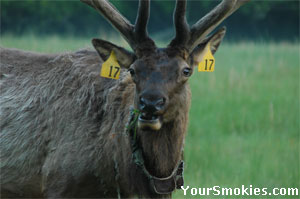
Great Smoky Mountains National Park Bull Elk

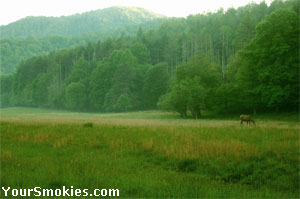
Elk cow grazing in the Smoky Mountains Park
The Great Smoky Mountains National park is where the park service started an experimental release program of North American Manitoban Elk (C. canadensis manitobensis) in a never ending quest to preserve native plants and animals of Smokies. Since it was man that removed all of the elk that lived in the Smokies, it is up to us to replace them.
These Elk are now the largest residents of the Great Smoky Mountains National Park and adult males elk (bulls) can weigh from 600 to 700 pounds and female cows average around 500 pounds. Adult Elk measure from 7 to 10 feet long and a bull elk can sport antlers that may be as wide as 5 feet from end to end. A full grown bull elk is an amazing sight.
The North American Elk (Cervus canadensis) also known as wapiti were once residents of the entire area that eventually become the national park, the Appalachian Mountains and other regions throughout the Eastern United States.
There was at one time 10 million elk roaming North America, but due to the encroachment of man and over hunting, the last North Carolinian Elk was killed in the late 1700's and sadly Tennessee lost its last Elk less than 50 years later.
Conservation organizations were already concerned during the late 1800's that the North American Elk was headed for sure extinction if action was not taken to preserve the species. Thankfully, these forward thinking conservationists were able to save at least some of the elk species from sure extinction.
Between 2001 and 2002 a total of 52 North American Elk were released in to the GSM national park, all wearing radio collars and ear tags in order to track the progress and range of the individual animals.
The first elk brought into the Cataloochee Valley were from Land Between the Lakes Kentucky. They were given yellow ear tags and allowed to acclimate to the area while being tested and observed to make sure they were disease free in a holding pen about a 1/2 mile up the Big Fork Ridge Trail. When released into the wild, most stuck around in Cataloochee.
The elk herd brought into the Great Smoky Mountains national park for the second release were from Elk Island in Manitoba Canada. These elk were given white ear tags and were released into the wild in what is called a hard release without any time for acclimation. These elk are very elusive and can be found outside the park and in Balsam Mountain.
The experimental phase of this program ended in late 2008 in order to determine if the elk do not threaten the delicate balance of the natural resources of the park or create significant danger or conflicts with the millions of GSM park visitors that come to the park each year and the farmers who raise crops and livestock close to the park.
Some reintroductions of threatened or eliminated species that once inhabited the park have been successful. Examples of successful reintroductions are the river otter, the peregrine falcon, and 3 different fish. Unfortunately there have been failures too such as the attempt to reintroduce the Red Wolf back into the park in Cades Cove. They were removed.
An Elks lifespan is around 15 years and its diet of as much as 35 pounds a day consists mostly of grasses, forbs and acorns but elk will also eat leaves, buds, and bark from both tress and shrubbery. There is more than enough high quality food for elk in the Great Smoky Mountains national park. If there was any question, elk would not have been reintroduced.
The elk have unfortunately have been fed by humans which has created problems with elk behaviours and in some cases severely reduced their life expectancy. Once human acclimated, the elk have no fear and will become agressive to humans to get food which can kill them. Elk also have developed a taste for salt and sometimes lick cars for the poisonous road salt.
When Elk cows are 2 years old they can give birth to one 35 pound calf every year after an 8-1/2 month gestation period around June. Though a calf is very dependant on the mother cow nursing from up until December to January, the calf can stand on its own within minutes of birth. Both cow and calf will join the herd within a few weeks of birth and the calves lose the spots on their coats by the end of summer.
Normal behavior of a mother will be to leave the calf alone while feeding. The calf will instinctively lie down and remain still to avoid detection by predators.
If you find an elk calf alone without its mother, back away and leave the calf alone. Do not touch the calf and leave the area at once as the mother is sure to be around and doing anything that the mother cow feels is a threat to its calf may cause a very unpleasant confrontation with an angry 500 pound extremely aggressive mother elk protecting her young and attacking you or those around you.
An angry mother elk is not the only elk to steer clear of, male bull elk are protective of their herd and territory especially during rut. They may perceive you as a threat and charge and attack you without being intentionally provoked by you.
Elk have a keen sense of smell and exceptional eyesight to detect movement which they will need to protect themselves from the predators of the park: black bear, coyotes and even bobcat which could prey on any sick, young or injured elk they can find.
Other predators that would normally pose a threat to the elk such as mountain lions and grey wolves no longer inhabit the Great Smoky Mountains national park or anywhere outside the park. No less than 5 Elk were poached.
The North American Bull Elks antlers are not just decorative attire but are used by the bull elk to attract female cows and intimidate and spar with one anther during rutting season which usually last from September into October. During this fantastic display there are few injuries to the elk as the sparring they conduct is mostly ritualistic.
You don't have to just see the rutting ritual to know that it is happening, you can actually hear the bulls bugling calls used to attract female cows and challenge other bulls up to a mile away. The Elks ultimate goal is to breed with his harem which may consist of up to 20 female elk.
Based upon the appearance of or lack of a bull elks antlers you can actually tell what time of the year it is and in the summer while an elk is still in velvet, it's antlers act like a radiator and help cool the bulls off.
In March the elk start to shed their antlers, however as soon as the elk shed their antlers they immediately start growing a new set. The larger bull elk may shed their antlers as late as April and the smaller elk bull with spikes shed their antlers much later in May to June.
If you happen to find an elks antlers in the park you must leave them alone as the elk's antlers are extremely rich in calcium and they are a food source for rodents and other small animals in the park that quickly devour them. It is illegal to possess antlers or other animal parts inside the park or remove antlers from the park.
By the end of summer in August when the bull elks testosterone level is increasing rapidly in preporation for the rut, the elks have shed their velvet and the antlers are fully grown. The picture of the bull elk at the top of this page clearly shows the velvet coat on his antlers.
To protect against the cold of winter, Elk have a specially developed a 2 layer coat. The bottom layer is a soft woolly underfur that keeps the animal warm and the top coat consists of long guard hair that repels water. In the top 2 pictures above on this page you can see that the Elk are shedding their winter coat. A lighter, copper colored single layer summer coat replaces the winter coat and often the male elk wallow in the mud to stay even cooler and to avoid insect that pester them.
Where to view elk in the Great Smoky Mountains National Park
There are about 155 North American Manitoban Elk now in the national park and unlike deer that inhabit every section of the park, there are only a few places in the park where the elk can be easily observed.
The best area to observe the elk is in the south eastern section of the park on the North Carolina side in the Cataloochee section right next to Maggie Valley. Cataloochee contains most of the elk herd and they can usually be observed in the large fields and by the historical buildings that are all accessible by your vehicle.
It will take you at least 45 minutes to get to the Cataloochee area of the national park from exit 20 on I-40. After 0.2 miles make a right onto Cove Creek Road which will take you 11 miles into Cataloochee valley which is fairly well marked. Be prepared to drive about 5 miles on an unimproved gravel road with little passing room and no guard rails. It is not wise to go into Cataloochee is snow is forecasted for the time you wish to be there as the roads become treacherous and will not be plowed.
It is now fairly common to see a handful of elk by the Oconaluftee Visitor center and the Farm Museum or further north of Oconaluftee in fields to the left and the right of Newfound Gap Road (US 441). The group of elk here is far smaller and you will not get to see the same behavior and interaction between the herd you can in Cataloochee.
Best times of the day to view elk in the park
The best times of the day to be able view elk in their natural habitat in the Great Smoky Mountains national park are early morning and just prior to sunset.
Since the elk like to stay in the shade during the heat of midday, you may also find that elk may also be active just before or after a rain storm or on cloudy days in the summer if it cools down enough for them.
How to view elk safely in the GSM national park
For the Elks safety and your own, to view elk you should be at a great distance - at least 150 feet. Use binoculars, a spotting scope, or a camera with a long telephoto lens in order to bring the action up close. The pictures on this page were taken by a professional nature photographer using an extremely powerful telephoto lens while being well camouflaged from the elk and at a great distance.
Besides your own personal safety that is risked from approaching wildlife too closely such as elk, you may cause them to expend crucial energy unnecessarily which can result in real harm to the animal.
How do you know if you are too close? If the elk stops feeding, if it changes direction of its movement or in any way alters its behavior because of your presence, you are too close to the elk!
Special laws in the park to protect the Elk
It is illegal to collect elk velvet, fur or antlers and you are never to feed or bait elk in order to observe them closer. It is also illegal to use elk bugles or other wildlife animal calls in order to attract or disturb elk in the national park.
Shinning of spotlights, flashlights or headlights to observe, disturb or attract elk is also strictly forbidden.
During birthing season (May, June and into July) and the Rut (September, October and into November)all fields in Cataloochee, Oconaluftee and the Smokemont areas are closed by law to entry even if elk are not present. This means even if there are no elk around, you can not walk into the fields and must remain by the roadside.
You must remain at all times of the year at least 150 feet away from elk as well as being far enough away not to disturb them in any way. If you are approaching an elk and it raises its head, or lifts its ears, you are disturbing it and breaking the law.
In the winter it is common in order to feed, Elk may move from the higher country to the valleys. Unfortunately Elk may travel beyond the safety of the boundaries of Great Smoky Mountains National Park in search of new territories.
In anticipation of this elk movement most of the non-crop land that is adjacent to the national park is designated as elk buffer zone. No action by the park service will be taken if elk move into these buffer zones as long as the animals do not cause significant property damage or other conflict. If any elk in this buffer are found to be a problem the National Park Service will remove the elk.
All lands outside the Elk buffer zone are designated as no elk zones and any Elk entering these areas will be removed by personnel from the National Park Service or state wildlife agencies.
It is illegal for anyone to kill an elk without a special permit from their state's wildlife management agency. Call (865) 436-1248 or (865) 436-1230 to report any elk you may see outside the national park.
The experimental North American Elk reintroduction in the GSMNP Project partners include: